
The mental game of volleyball
Managing practice, study hall, weights, film sessions, being a full-time student, traveling, maybe working, and being held to a higher standard because you are representing your own university…..
These are all factors that a Division 1 athlete must live with. All of these circumstances may be quite overwhelming at times, especially if you do not have the correct mentality or state of mind while handling all these factors at once. Many may not realize it, but these are all elements that partake in your mental health on and off the court. It is not just about the game itself, in fact, it rarely is only the playing part of the game, your mental toughness and mental strength comes from your surroundings and what you allow to affect you or not.
Some tips I would suggest overcoming the many stressors of being division 1 athlete:
o Take everything step by step, do not view all of your tasks you need to complete as a whole, take it one at a time and check it off as you go; therefore it will not seem so overwhelming.
o Learn how to adapt quickly in different environments [Be comfortable being uncomfortable]
o Establish a good relationship with those around you. That being your professors, mentors, coaches, teammates, etc.
o Utilize the help you that’s offered around you.
o Make the most of your own failures do not view them as a negative but view them as a way to get better and improve.
o Learning to manage time wisely, and not get distracted easily
o Not allowing outer influences deter you from accomplishing small or large goals you have for yourself
o Remaining positive throughout long/tough days between school and practices
o Remembering your passion for the game and how blessed you are to be where you’re at
“You’re too short,” You’ll never compete at a division 1 level”, “You are not good enough.”
We have all experienced some sort of negative outer response in our lives, whether it be within our sport or life in general. These are just a couple of comments I had received throughout high school that could’ve defined me if I allowed it to. Without practicing mental toughness, these specific comments could have ruined my chances of playing at a division 1 level currently. I think everyone could agree it is not a good feeling, and some may not know how to respond to those negative encounters. As a volleyball player, there are many obstacles and challenges you may experience while aspiring to achieve your goals/dreams. Something you must remember is who you are and why you are doing what you are doing. “Take pride in what you do, and always work for what you want to achieve.” This is something I would tell myself constantly throughout my years of playing. You must always remember that the journey to success will not always be an easy task. Along with every journey you may encounter, not just in volleyball, you will come across a couple of bumps in the road. How you respond to those situations is what will determine how much you can conquer. Remaining positive and continuing to drive and push yourself is the best way to achieve your goals. Your body will pinpoint the negative and the stress you’re feeling while in state of competition. Knowing what you must do, and having the discipline and determination to focus on your goals with “blinders on”, is a substantial mental skill to be achieved. There are three mental skills that I have come across that have helped me defeat negative energy. For example, setting goals for myself, being weekly, monthly or yearly, mental rehearsal (visualization), and lastly self-talk. The most important mental skill to me is self-talk.
Self-talk can either “make you or break you”. This is in a sense that you can feed yourself with positive or negative self-comments. With me, after making a particular mistake, I would say, “get the next one,” “make it up with a good dig or pass,” or “you got the next one.” This is good positive self-talk that can help hinder those negative thoughts from coming about. When making a mistake many players overthink that specific mistake. For example, say you are serving, and you hit the ball out or into the net. The following time around, many players are thinking about how they do not want to make that mistake again and are overthinking that specific mistake. This is where self-talk may come into play. As a volleyball player or any athlete for that matter, you must achieve mental toughness to learn from your mistakes and adapt to new environments. Without mental toughness, it will be challenging to get over a funk you may be in.
Volleyball is a sport known for its fast pace and sudden momentum shifts. In order to compete at an elite level, you must achieve the skill of overcoming mistakes, getting back on your feet and keep playing the game you know while not allowing any alternative negative thoughts enter your mind or overthinking an particular error. Visualization is also an excellent mental skill to be used within competition and practice. For visualization, I imagine me making a great dig out of a hard hit or making an awesome save out of a bad pass. When visualizing positive acts, you want to put out on the court, the more likely those things are bound to happen. It is very similar to speaking words into existence.
Lastly, always remember it is all more than just your performance and expectations. It is what you are surrounded by, for example, your teammates and the environment you put yourself in. The external factors affect you more than you’d ever expect, and if those elements are not predominantly a positive facet in your life, it can be complicated to maintain that healthy mindset on and off the court. How your mind works on the court is also a reflection of how your mind will work in the real world. All of these skills will help you prepare better outside and inside of the volleyball court.

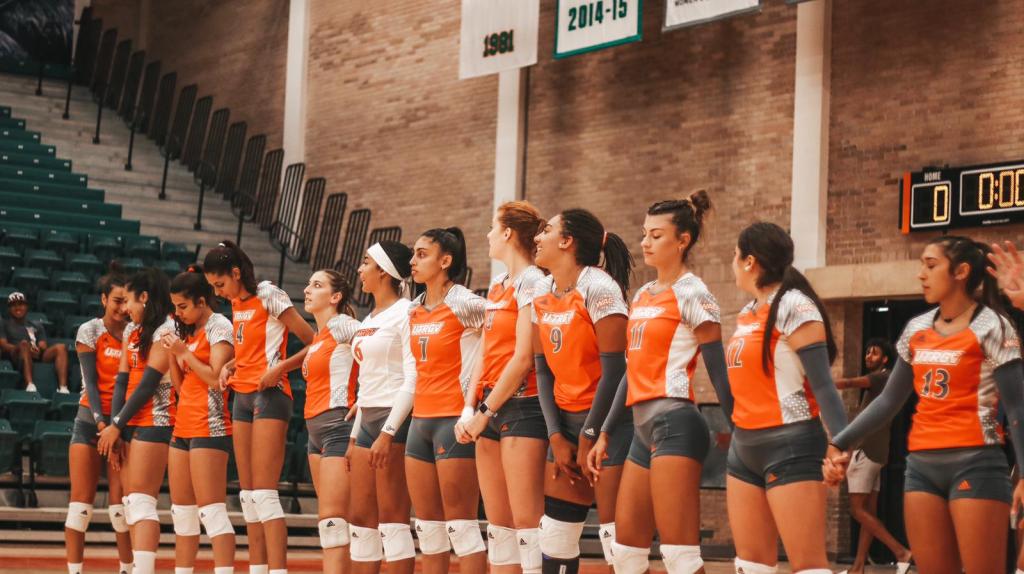
 UTRGV Volleyball